Check Engine Light
Specialists
That Check Engine Light on Your BMW or Mercedes Isn’t Going to Diagnose Itself
Quick Takeaways
- The check engine light can indicate 100+ different fault codes — only a proper diagnostic scan reveals the actual cause
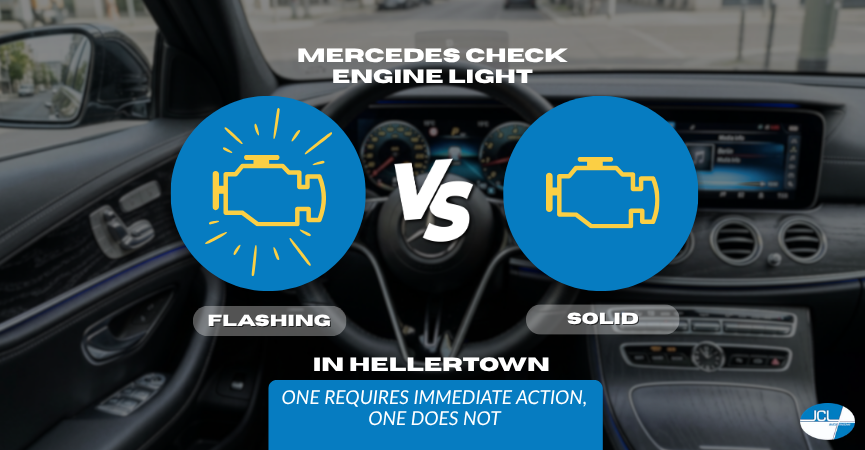
- A solid CEL means drive to a shop soon; a flashing CEL means pull over now (active misfire damaging your catalytic converter)
- European vehicles store codes across multiple modules — a generic OBD-II reader at an auto parts store won’t catch everything
- Clearing the code without fixing the cause always brings it back
- JCL uses factory-level diagnostic equipment, the same as the dealerships
High-Quality Check Engine Light Diagnostics for Hellertown Area Drivers
Most drivers see the check engine light come on and do one of two things: panic or ignore it. Neither is the right call. The check engine light on a European vehicle — a BMW, Audi, Mercedes, or Tesla — is not a one-size-fits-all warning. It can mean something as minor as a loose gas cap or as serious as a catalytic converter meltdown in progress. The only way to know is a proper diagnostic scan at a shop equipped to read your specific vehicle. JCL Automotive in Hellertown has the factory-level tools and ASE-certified technicians to find out exactly what is going on — and tell you what it actually means before any repair work begins.
Quality Service for the Top European Brands
At JCL Automotive, our certified mechanics have decades of experience working with European vehicles. We welcome domestic & foreign cars but specialize in all models of:



What Is Your Check Engine Light Actually Telling You?
Your check engine light — technically called the malfunction indicator lamp, or MIL — is tied to your vehicle’s onboard diagnostic system. When any sensor in the emissions, drivetrain, fuel, or ignition system detects a reading outside normal parameters, it stores a fault code and illuminates the light. On most European platforms, there are more than a hundred possible codes covering dozens of systems.
The solid versus flashing distinction matters more than most drivers realize. A solid light means the system has detected a fault and you should get it diagnosed within a reasonable timeframe — driving another few days is usually fine, but weeks of ignoring it is not. A flashing check engine light is a different situation entirely. That almost always indicates an active engine misfire, meaning raw, unburned fuel is entering your exhaust system. Catalytic converter damage can happen within miles. If your light is flashing, pull over, let the engine cool, and call for a tow if the car is running roughly.
Why a Parts Store Scanner Won’t Cut It on a European Vehicle
When the check engine light comes on, many drivers head to an auto parts store for a free code scan. That tool reads generic OBD-II codes from the engine control module. On a European vehicle, that gives you perhaps a third of the picture at best. BMW, Audi, and Mercedes each store fault codes across multiple control modules — the transmission control unit, ABS module, body control module, instrument cluster, HVAC controller, and more. A generic OBD-II scanner cannot access those modules.
You might leave with a single P-code printed on a receipt while the actual root cause sits in a secondary module, completely invisible to the parts store tool. Clearing that single code at the counter and driving away changes nothing. The fault returns because the underlying condition was never diagnosed or repaired. Factory-level diagnostic equipment reads the full picture across every module in the car simultaneously, which is exactly how JCL Automotive approaches every check engine light diagnostic in Hellertown.
Common Check Engine Light Causes by Brand: BMW, Audi, Mercedes & Tesla
BMW
BMW drivers in the Hellertown and Lehigh Valley area come in most often with VANOS fault codes. The variable valve timing system on BMW engines is effective but wear-prone as mileage climbs, and a failing VANOS solenoid will trigger a check engine light while the car runs noticeably rough. Crankcase ventilation failures are equally common on BMW inline-six and V8 engines — the CCV membrane deteriorates with heat cycles, causing oil consumption and stored fault codes. Coolant temperature sensor faults will illuminate the CEL while subtly misreporting engine temperature to the fuel management system. Catalytic converter efficiency codes appear frequently on higher-mileage BMWs and often trace back to upstream oxygen sensor degradation rather than the converter itself.
Audi
Audi owners deal with the complexity of the VAG platform, which stores codes across every module in the car. What looks like a drivetrain fault can sometimes trace to an adaptive driving system or MMI interface issue — getting an accurate diagnosis requires reading the full module tree, not just the engine ECU.
Mercedes-Benz
Mercedes vehicles running COMAND or MBUX software can generate software-level check engine codes that resemble mechanical faults in a generic scan. Mercedes Star Diagnostic equipment is required to separate a real mechanical issue from a software flag.
Tesla
Tesla owners should know that a Check Vehicle alert is not the same as a traditional check engine light. Over-the-air diagnostics handle many software faults remotely, but battery management system issues, inverter faults, and drive unit problems require hands-on inspection.
What the Diagnostic Process Looks Like at JCL
When you bring your car into JCL Automotive with the check engine light on, the process begins with a full multi-module scan — not just the engine control module. The technician reads all stored fault codes across every accessible module, reviews freeze-frame data showing the operating conditions present when the fault triggered, and checks for pending codes sitting below the threshold to illuminate the light but building toward it.
From there, the diagnosis moves to physical testing. Fault codes point toward a system, not necessarily a specific part. A misfire code, for example, could trace to a spark plug, ignition coil, fuel injector, or fuel pressure issue. JCL identifies the actual cause before any repair is recommended. If the diagnosis reveals a deeper mechanical problem, you will not need to move the car — engine repair in Hellertown is handled at the same shop with no need to transfer the vehicle to another facility.
Why Hellertown Area Drivers Choose JCL for European Diagnostics
JCL Automotive has been working on European vehicles since 2005. The shop uses factory-grade diagnostic equipment — the same tools the dealerships use — and every technician is ASE-certified. That combination means the shop can read and interpret the data generated by BMW, Audi, Mercedes, and Tesla systems, rather than guessing from generic codes.
Every repair carries a 24-month, 24,000-mile nationwide warranty, covering both parts and labor. You receive text and email updates as your car moves through the shop, and same-day service is available when the schedule allows. Drivers coming from across the Lehigh Valley can also review the European auto repair near Bethlehem service area page to confirm coverage before scheduling. Owners of Mercedes vehicles will find that JCL has the Star Diagnostic equipment needed to accurately diagnose COMAND and MBUX-equipped models. Drivers looking for Mercedes repair specialists in the Lehigh Valley will find the full scope of Mercedes diagnostic and repair services on the JCL Mercedes page. The shop is at 70 Main Street in Hellertown, easy to reach from Bethlehem, Allentown, and Easton.
Schedule Your Diagnostic at JCL Automotive
If your check engine light is on — solid or flashing — JCL Automotive has the factory-grade equipment to find out exactly what is wrong. The shop is staffed by ASE-certified technicians and has been specializing in European vehicles since 2005. Every repair is backed by a 24-month, 24,000-mile nationwide warranty.
Call (484) 851-3390 to schedule, or stop by at 70 Main Street, Hellertown, PA 18055. Hours are Monday through Friday, 8:30 AM to 6:00 PM. You can also visit jclautomotive.com to learn more about services and book an appointment online
Frequently Asked Questions About Check Engine Light Service
What does a check engine light mean on a BMW?
On a BMW, the check engine light can indicate anything from a VANOS solenoid fault or crankcase ventilation failure to an oxygen sensor issue or catalytic converter efficiency code. Because BMW stores codes across multiple control modules, the only accurate way to diagnose it is with factory-level scanning equipment that reads all modules — not just the engine ECU. A generic OBD-II scan from a parts store will not give you the full picture.
Is it safe to drive with the check engine light on?
If the light is solid and the car is driving normally, it is generally safe to drive for a short period, but you should get it diagnosed soon rather than waiting weeks. If the light is flashing, you should pull over as soon as it is safe to do so. A flashing check engine light almost always means an active engine misfire, which can damage the catalytic converter within miles of continued driving.
Why does my check engine light keep coming back after being cleared?
Because the underlying fault was never repaired — only the code was erased. The onboard diagnostic system re-detects the same condition and re-illuminates the light, usually within one to three drive cycles. Clearing a code is not a fix. Until the root cause is diagnosed and corrected, the light will return. This is especially common when a parts store scans the car, clears the code, and sends the driver on their way without identifying the actual issue.
What is the difference between a flashing check engine light and a solid one?
A solid check engine light means a fault has been detected and stored, but the condition is not causing immediate severe damage. You should have it checked within a few days to a week. A flashing check engine light indicates an active misfire — the engine is firing cylinders incorrectly and sending unburned fuel into the exhaust. This can destroy the catalytic converter in a very short time. Treat a flashing check engine light as an urgent warning, not a minor inconvenience.